

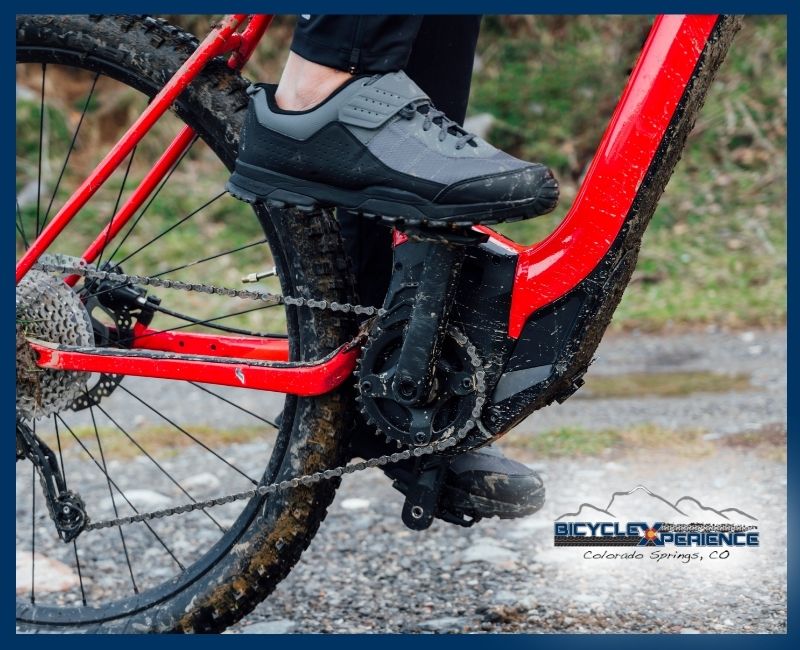
Most of the buzz around Colorado’s eBike incentives focuses on commuter bikes and budget models. But if you’re eyeing an electric mountain bike, there’s good news: the state’s tax credit discount works for you too, and that’s not true of every program out there.
The discount, in one line
Coloradans can get $225 off a qualified eBike at a participating retailer, applied right at the register. It’s one discount per resident per calendar year.
Why eMTB riders should pay attention
Colorado also runs an income-qualified rebate, but it excludes full-suspension mountain eBikes and limits standard eBikes to a $5,000 purchase price. A lot of trail-ready eMTBs fall outside those rules.
The tax credit discount doesn’t have either restriction. The state lists no minimum and no maximum purchase price, and full-suspension eMTBs are not excluded. So whether you’re looking at a $3,000 hardtail or an $8,000 full-suspension trail bike, the same $225 comes off at checkout.
What your eMTB needs to qualify
The bike has to meet the state’s general eBike requirements:
- New (no used bikes)
- Certified to UL 2849 or EN 15194
- Electric motor of 750 watts or less, not gas-powered
- Two or three wheels with working pedals
- Class 1, 2, or 3
One thing to watch for: bikes with an “off-road” mode that goes beyond the three-class system, or that can reach more than 20 mph on throttle alone, don’t qualify under the state’s definition (as of August 2025). If you’re comparing models, ask about this before you fall in love with one. We’re happy to check specs with you.
What to bring
- A document that shows your physical Colorado address, dated within three months of your purchase (a driver license or ID, utility bill, or bank statement are common choices)
- A few minutes at checkout to sign a short affidavit form, which the shop sends along to the Colorado Department of Revenue
A few things to keep in mind
- The discount doesn’t cover sales tax. You pay the full tax on the bike.
- You can use it once per calendar year, so it’s worth thinking about which purchase you want to apply it to.
- Accessories, gear, and service are separate from the bike purchase, so ask us how they fit into your budget.
Come ride with us
Trying out an eMTB is the best way to know if it’s the right fit. Stop by 1601 S. Tejon St. in Colorado Springs or call (719) 473-1015, and we’ll help you find a bike that qualifies and handle the paperwork. For the official rules, see the Colorado Energy Office eBike tax credit page.
Internal notes (do not publish)
Publish Blog 1 before Monday, October 19, then Blogs 2, 3, and 4. All program facts come from the state pages (rebate, tax credit), as Shawn asked.
Left out on purpose (client confidential)
- The tax credit increase planned for January.
- The state payment to the shop that improves margins. Note: the state page lists a $250 retailer credit, while Shawn’s email says $500, so it may be worth asking him about it. It stays out of public copy either way.
- Nothing is worded as “$225 forever,” so the posts won’t need a rewrite when the amount changes.
Where the posts follow the state page instead of the email
- The state describes the “tax credit” as a $225 discount applied at the register, with the shop claiming a credit from the Colorado Department of Revenue. Blog 2 says this so readers don’t expect to claim it on a tax return.
- The rebate is a random selection after registering, not guaranteed enrollment. Blog 1 says so.
- The state page adds a $5,000 price cap on standard eBikes for the rebate. Shawn’s email didn’t mention it.
Confirm with Shawn before publishing
- Bicycle Experience is listed as a participating retailer for both programs (the posts say “come see us” and imply that it is).
- Lectric and Aventon models are named only as popular picks. Check that the models he sells meet the rules (new, UL 2849 or EN 15194 certified, 750 W or less, no “off-road” mode beyond the three classes, and $5,000 or less for standard bikes under the rebate).
- Phone number and address come from his email signature.
Update after the window closes
Blog 1 and the table in Blog 3 point to the October 19-26 window. After October 26, switch the call to action to the next window (January 11-18, 2027) and keep the later dates (March 15-22, 2027) in mind.